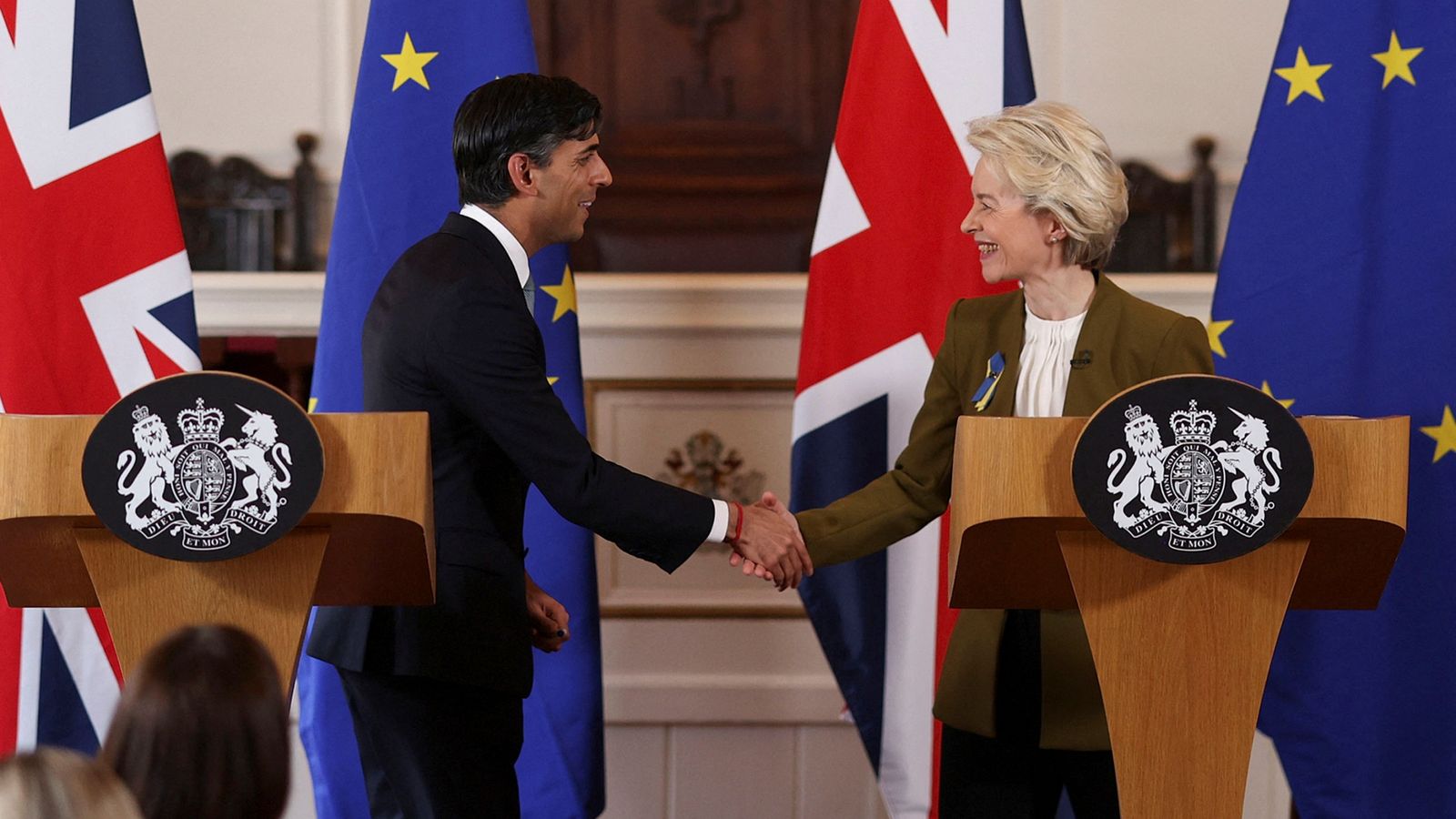
In recent weeks, while Turkey’s national focus has been divided between post-earthquake humanitarian relief and the political tremors shaking its opposition coalition, a major geopolitical development unfolded between the United Kingdom and the European Union. Following intensive negotiations, both parties announced a landmark agreement to overhaul the Northern Ireland Protocol—a longstanding friction point in post-Brexit relations. Known as the Windsor Framework, this critical compromise aims—pending sufficient domestic political support—to safeguard peace and stability in Northern Ireland while paving the way for the UK to recalibrate its relations with both the EU and the United States on a more constructive footing.
The Northern Ireland Protocol and the Customs Border Dilemma The Northern Ireland Protocol governs trade between Northern Ireland (part of the post-Brexit UK) and the Republic of Ireland (an EU member state). To uphold the 1998 Good Friday Agreement and avoid a hard land border, the UK and EU initially agreed that Northern Ireland would remain aligned with certain EU customs rules after Brexit. This successfully prevented a physical border on the island of Ireland.
However, Brexit inevitably necessitated customs checks somewhere. The rhetoric of then-Prime Minister Boris Johnson, who negotiated the initial withdrawal terms, could not obscure this reality. Ultimately, both sides agreed to conduct trade checks across the Irish Sea. Yet, as the practical disadvantages of leaving the EU Single Market and Customs Union became apparent, the Johnson administration demanded a fundamental overhaul of the protocol, invoking Article 16 to exempt UK goods bound for Northern Ireland from checks. In June 2022, his government went so far as to introduce legislation in the House of Commons to unilaterally overwrite key parts of the protocol.
This threat of unilateral action undermined the UK’s international credibility, strained ties with Brussels, and derailed bilateral cooperation across multiple sectors. The friction surrounding the protocol also paralyzed Northern Irish politics. Following Sinn Féin’s historic election victory in May 2022, the Democratic Unionist Party (DUP) boycotted the power-sharing executive in protest of the protocol, preventing the formation of a government. Furthermore, as political instability rocked the region, US President Joe Biden—who takes pride in his Irish heritage—expressed deep concern for the peace process, adding further strain to transatlantic relations.
The Sunak Factor The appointment of former Chancellor Rishi Sunak as Prime Minister last October, following a turbulent Conservative leadership contest, opened a fresh window of opportunity to resolve the impasse with Brussels. In stark contrast to his predecessors, Boris Johnson and Liz Truss, Sunak adopted a pragmatic and conciliatory posture. This approach was warmly received in Brussels and strongly backed by Washington, which favors unity among its Western allies. High-level diplomatic engagements swiftly helped rebuild eroded trust.
The foundations of the Windsor Framework were largely laid during the Sunak-Biden bilateral meeting at the G20 Summit in Bali. Sunak committed to resolving the Protocol disputes—which were souring EU relations and endangering the Good Friday Agreement—before the agreement’s 25th anniversary in April. Tellingly, discussions regarding a potential UK-US Free Trade Agreement, long sought by London, resurfaced alongside these negotiations, signaling that progress on trade with Washington was contingent upon resolving the Northern Irish dispute.
What Does the Windsor Framework Deliver? Unlike previous arrangements, the Windsor Framework provides a pragmatic compromise designed to streamline trade while addressing sensitive concerns over sovereignty and the UK's internal market. Crucially, it introduces a two-tier system: a "green lane" for goods moving from Great Britain to Northern Ireland that are intended to remain there, and a "red lane" for goods at risk of entering the EU single market.
Goods staying within the UK internal market via the green lane will be freed from cumbersome customs procedures, dramatically cutting paperwork and restoring commercial flow. The ban on items such as chilled meats (which sparked the infamous "sausage wars") and certain cheeses has been lifted, and parcel shipments between Great Britain and Northern Ireland are exempt from routine customs declarations. Additionally, human medicines approved by the UK regulator will be available in Northern Ireland without requiring European Medicines Agency approval, and onerous pet travel documentation has been scrapped.
To address sovereignty concerns—a major sticking point under the original protocol, which granted the European Court of Justice (ECJ) sole jurisdiction—the new framework establishes an independent arbitration panel comprising UK, EU, and Northern Irish representatives. Most notably, it introduces the "Stormont Brake," allowing the Northern Ireland Assembly to veto new EU goods regulations under specific conditions. By building on the 1998 Good Friday Agreement's principle of cross-community consent, the mechanism gives Northern Ireland a say in the application of EU rules.
Political Reactions and Prospects Although the Windsor Framework does not take the form of a new international treaty, Prime Minister Sunak has committed to putting the agreement to a vote in the House of Commons. Its ultimate fate hinges on the stance of backbench Conservative MPs, the opposition, and the DUP.
Labour leader Keir Starmer, currently leading in national polls, voiced support for the framework as a crucial step toward easing UK-EU tensions. The situation within the Conservative Party, however, remains delicate. Concerns persist that Boris Johnson—hoping to engineer a political comeback—might mobilize hardline Brexiteers against the deal. Although Johnson signaled he would struggle to vote for the agreement, he acknowledged public appetite for ending the protracted feud with Brussels. Meanwhile, the European Research Group (ERG), representing the Conservative right wing, indicated it would align its vote with the DUP. While the framework significantly reduces friction on sea-border trade, the DUP remains cautious about the lingering presence of EU law in Northern Ireland. Nevertheless, as party leaders digest the fine print, pragmatic voices seeking the broader strategic benefit may ultimately prevail.
Securing parliamentary approval for the protocol would mark a major diplomatic triumph for Sunak as he navigates a severe domestic cost-of-living crisis. A genuine thaw in UK-EU relations would unlock broader cooperation—from tackling illegal migration to rejoining joint scientific research initiatives. Indeed, the EU’s announcement immediately following the agreement that it would pave the way for the UK's re-entry into the Horizon Europe research program serves as a tangible gesture of goodwill.
A warmer relationship between London and Brussels is equally welcomed in Washington, where the Biden administration is keen to maintain Allied unity amid the ongoing war in Ukraine. In Congress, US senators have already indicated that a bilateral free trade agreement may be back on the table, hinting at potential breakthroughs during President Biden’s planned visit to the UK in April.
Conclusion It is somewhat paradoxical that a diplomatic effort primarily focused on damage control after Brexit is being framed as a major success story. The gap between the promises of the 2016 Leave campaign and economic realities continues to widen. Yet, as Sunak prepares to meet French President Emmanuel Macron at the Élysée Palace to coordinate anti-smuggling efforts in the English Channel, one reality is undeniable: maintaining a close, constructive partnership with Europe remains essential to the United Kingdom's national interest.