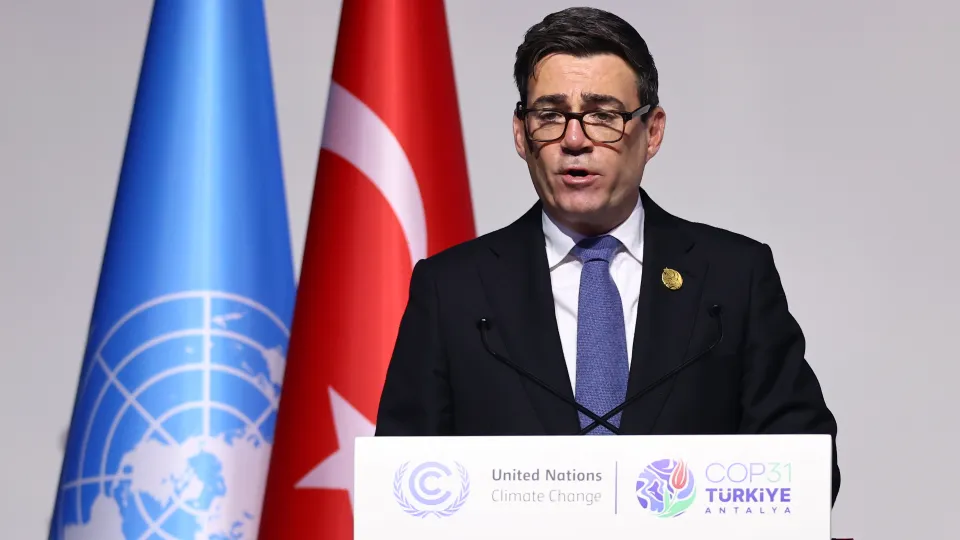
At the 31st UN Climate Change Conference (COP31) in Antalya this year, British Prime Minister Andy Burnham insisted the UK would step up and lead on climate action, even as global consensus fractures. That Burnham was the only G7 leader to show up says a great deal about how far climate change has slipped down the international agenda. At home, however, the crisis is impossible to ignore. Britain has just come through its hottest, driest summer on record, leaving water supplies dangerously depleted. As Burnham himself put it, climate change is no longer a distant threat to prepare for—it is already here. Yet strip away the rhetoric, and Britain’s actual climate record looks decidedly more complicated.
Britain’s Climate Balance Sheet: Gains and Vulnerabilities
Since 1990, the UK has cut its carbon emissions by more than 50%, faster than any other G7 nation. In 2024, the birthplace of the Industrial Revolution became the first G7 member to stop burning coal for electricity altogether, while renewables now generate 52% of its power. In Antalya, London also reaffirmed its backing for the “35 by 35” Global Electrification Pledge—championed by Türkiye’s COP31 Presidency—which aims to raise electricity’s share of final energy consumption to 35% by 2035.
That is the encouraging half of the story. The other half is shaped by geopolitical upheaval. Four years into the Russia–Ukraine war, the outbreak of fighting between Iran, the United States, and Israel in 2026 has sent global energy prices and inflation surging once again. For a Labour government already hemmed in by a persistent cost-of-living crisis, those shocks have forced painful choices. Since taking office in August, Burnham has tilted toward energy security and job protection, quietly retreating from some of his predecessors’ tougher climate benchmarks and easing off the 2050 Net Zero accelerator.
Green campaigners accuse ministers of rank hypocrisy—lecturing the world on phasing out fossil fuels while waving through major oil and gas projects in British waters. Still, a harder question is gaining currency in Westminster: until the geopolitical storm passes, are transitional compromises the only realistic way to keep long-term climate targets intact?
Energy Security Under Geopolitical Strain: Jackdaw and Rosebank
In January 2025, Scotland’s Court of Session quashed the original permits for two major projects: the Jackdaw gas field in the North Sea and the vast Rosebank oil field in the North Atlantic. After redoing the environmental assessments, however, the government cleared Jackdaw for production last October under Adura, a joint venture between Shell and Equinor. The Department for Energy Security and Net Zero argues the field will inject £1.4 billion into the economy, support more than 1,000 jobs, and boost domestic gas output by 6% just as winter sets in. Britain currently produces only about 42% of the gas it consumes, relying on Norway for 37% and importing roughly 20% as liquefied natural gas (LNG)—a stark measure of its exposure to external supply shocks.
Rosebank remains caught in the regulatory pipeline, and the project has split the Cabinet down the middle. Chancellor John Healey wants it approved for the tax receipts it would bring the Treasury; Energy Security Secretary Miatta Fahnbulleh and Foreign Secretary Ed Miliband oppose it, warning that greenlighting a massive oil field would shred Britain’s credibility on climate leadership. According to the campaign group Uplift, Rosebank would generate roughly 254 million tonnes of carbon dioxide equivalent over its lifetime—equal to 70% of the UK’s entire annual emissions in 2025.
Critics argue the economic and security case for Rosebank is just as weak. Roughly 90% of the field’s reserves are oil, with gas making up just 10%. While that gas would feed the domestic grid, Equinor’s estimate of 300 million barrels of oil amounts to barely eight months of UK consumption. Worse still, British refineries are not equipped to process Rosebank’s heavy crude, meaning virtually every barrel would be sold abroad.
For ministers backing the project, the appeal is straightforwardly fiscal: taxing corporate profits on those oil sales. Combined with Jackdaw, developing the fields, operating Floating Production, Storage and Offloading (FPSO) vessels, and maintaining offshore supply chains promise billions in investment and thousands of jobs across Britain’s maritime and energy sectors. Environmental groups counter that generous capital and investment allowances under the UK’s corporate tax rules mean oil companies will pay almost nothing in the early years, until they have recouped their upfront costs and turned a net profit.
Easing Off the Green Transition: Housing and Motoring
The government’s willingness to stretch its green timetable is just as visible in domestic policy. Ministers have delayed mandates requiring households to replace fossil-fuel boilers, and they have taken a similarly conciliatory line with carmakers over Zero Emission Vehicle (ZEV) quotas. While the UK still legally requires manufacturers to ensure that 33% of new cars and 24% of new light commercial vehicles sold in 2026 are zero-emission, rule changes announced in April 2025 and enacted in January 2026 tilted the system in the industry’s favour. Former Prime Minister Keir Starmer had honoured a manifesto pledge by pulling the ban on new pure petrol and diesel cars back from 2035 to 2030, but he softened the blow by giving automakers longer to borrow and repay emissions credits. Hybrids were granted a five-year reprieve until 2035, and fines for missing annual targets were cut from £15,000 to £12,000 per vehicle.
Burnham has stuck closely to Starmer’s script on electric vehicles. At COP31, he stressed that bringing down purchase prices is essential to getting ordinary drivers into EVs. True to that logic, one of his first acts in Downing Street was to scrap VAT on household electricity bills—a move pitched as cost-of-living relief that also happens to make home EV charging noticeably cheaper. Yet drivers who rely on public charging points still face a 20% VAT rate, leaving a glaring contradiction at the heart of the policy.
Walking a Political and Fiscal Tightrope: The Energy Wealth Fund and Legal Carve-Outs
Britain is trying to expand renewable power and broaden the low-carbon transition without alienating voters or squeezing industry too hard. Over the medium term, generating more clean electricity at home should at least partly shield household bills from swings in global gas markets.
To blunt the political fallout from Jackdaw and Rosebank, the government used its October Budget to unveil an Energy Wealth Fund, designed to channel tax revenues from North Sea oil and gas directly into clean-energy projects. Days later, on 4 November 2026, ministers introduced the Energy Independence Bill in Parliament to ban new oil and gas exploration licences in the North Sea. Crucially, however, the bill carves out exemptions for both Jackdaw and Rosebank—and the Treasury’s 2026 budget forecasts already count on tax revenues from both fields going ahead.
What emerges is a government trying to square its fossil-fuel pragmatism with its green commitments. London has not abandoned the fight against climate change, but geopolitical pressure has forced it to recalibrate its ambitions and stretch out its Net Zero timeline. Yet in an age when climate change has itself become a direct threat to national security, the real test is whether buying short-term stability with new fossil-fuel approvals will only leave Britain more exposed in the years ahead