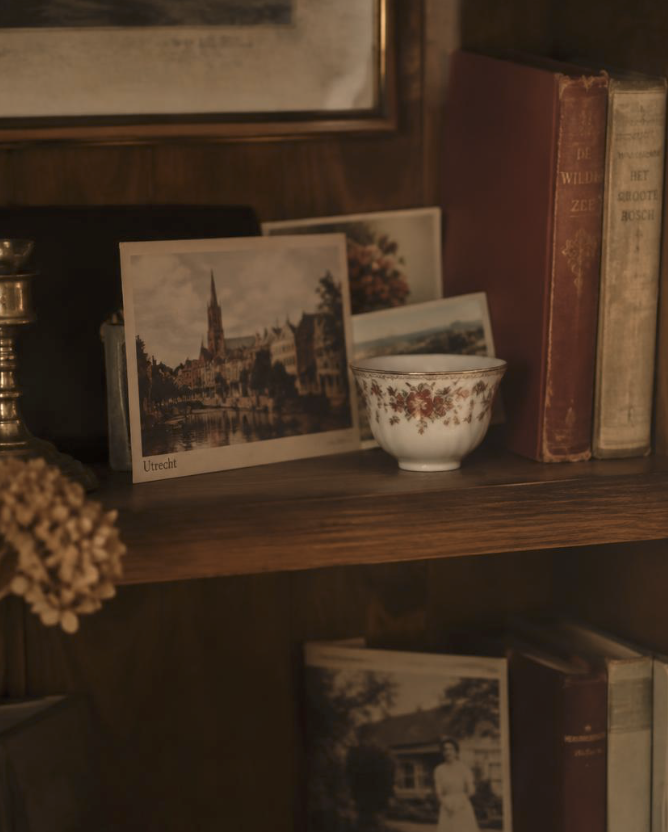
What is your relationship with the things you own? Are you someone who hoards every sentimental trinket, or do you live by a throwaway culture? Do you keep a collection you guard with your life—books, postcards, vintage scale models, or something else entirely? Do you ever wonder whether whoever inherits your belongings will treat them with the same tender care? Or what price tag a second-hand dealer might slap on them?... Can we truly measure the value of an object by its price tag?
One of the hardest moments after losing a loved one is sorting through their personal effects. It goes far beyond a simple organizing task; it forces you to run your memories through a fine sieve. A seemingly worthless object can end up playing the lead role in a memory, whether cherished or painful. Like the lampshade whose glass globe I broke, earning my very first and only spanking; a faded pair of castanets with a flamenco dancer painted on them that used to send me drifting into daydreams; or the record player I wasn't allowed near as a child...
Photos in the Drawer and a Button Box
When I lost my grandmother—who was like a second mother to me—I remember going to clear out her home, emotionally shattered, entering a space even more disordered than my own mind. Although there were valuable antiques in the house, my very first instinct was to head straight for the drawer where I knew she kept the family photos. I gathered every single one. The only other thing I took with me as I walked out—strange as it may sound—was her button box.
Back in the day, when doctors made house calls, she kept those buttons stored inside a black leather bag with a metal clip at the top, just like a doctor's vintage medical bag. My grandmother was a gifted seamstress. While she sewed, I would sit beside her, playing with the buttons inside that bag. Growing up in a pre-tablet era meant inventing your own games and toys using pure imagination. She had buttons in every imaginable shape and striking color. The moment I opened the closet that day and found that bag, I was instantly transported back to being that little girl sitting on the carpet, lost in play. Had I not taken it, it likely would have been thrown into the trash. What appeared completely worthless to anyone else was priceless to me.
Family Ties Reflected on Stage
That was precisely why Arthur Miller’s play The Price, which I saw in London a while ago, transported me straight back to that afternoon, standing in front of my grandmother's closet. Seeing that story unfold on stage reminded me of the deep chasm between the price tag on an object and its place in our hearts.
The story centers on two estranged brothers meeting 16 years after their father’s death to sell off the furniture in their childhood home before the building is demolished. They hire Gregory Solomon—an aged, shrewd vintage dealer with an uncanny read on human nature—to appraise the items. As Solomon inspects the furniture, the brothers begin sifting through the emotional wreckage of their shared past.
In one scene, Victor, the elder brother, discovers an amateur radio he built as a boy hidden among the furniture. We learn that despite his talent and passion for science, he sacrificed his education to join the police force so he could support his father, who lost everything in the 1929 crash. The handmade radio he desperately clings to—or the fencing gloves the brothers used to play with before their relationship was clouded by resentment—stop being mere objects and transform into living witnesses of the past, much like my grandmother's button box.
Parting with Emotional Baggage
Looking at that stage piled high with furniture, I realized the claustrophobic clutter wasn't just set design. It was a physical manifestation of the heavy emotional baggage the family members had carried for decades.
At the end of the day, Solomon, the old dealer who leveraged every bargaining trick in the book, was the only one who profited in financial terms. The brothers, in exchange for the cash raised from selling their past, were forced to confront the true cost of their life choices. Perhaps translating the play's original title as "Bedel" (Cost/Consequence) rather than "Fiyat" (Price) in Turkish was intended to emphasize this exact confrontation.
Parting with objects ultimately brings us face-to-face with a choice: which memories do we keep, and which ones are we ready to make peace with and leave behind? In the final act, when Victor chooses to keep the fencing gloves—representing his sacrificed youth—over the harp, arguably the most valuable item in the house, Miller delivers his most poignant message: what gives an object its true meaning can never be priced.
As for myself, I certainly don't want to leave behind a house full of clutter for my own children, but as long as I live, I will hold on to my button box. Regardless of its financial value, it is a bridge to that little girl inside me.