October 2026
A long time ago, I made a promise to myself: every year, I would try at least three activities I’d never done before. In my third year after moving to London—once the worst of Covid was behind us—I joined the SJWWC Women’s Club on a friend’s recommendation. For a modest annual fee, the club gives members access to everything from sightseeing trips and art workshops to talks by guest speakers and various social events. Its main focus, though, is bringing its predominantly expat community closer together.
As a project I’d been working on was drawing to a close, I realized I’d started neglecting myself again. Learning from past experience, I felt I needed to slow down a bit this time, so I decided to take a look at the club’s schedule. An announcement for an art workshop caught my eye. It was being hosted alternately by two members, Carolina and Kristy. Honestly, I couldn't quite tell what to expect from the description, but I signed up anyway.
When I arrived, a group of women were chatting in the living room, coffee/tea in hand from the kitchen. There were about ten of us—roughly the same age, but from all different backgrounds. After quick introductions, Kristy and Carolina introduced the theme for the week: "Play." They asked us to reflect on what playing games meant to us. But first, we were going to play one.
We formed a circle in the living room. They asked us to count from 1 to 20, taking turns at random without following a set order. If more than one person spoke at the same time, we had to start over from the beginning. The point of the exercise was to feel each other’s presence and get on the same wavelength. After a few tries, we made it. Kristy then prompted us to focus on our reactions and body language whenever we made a mistake: Did we feel embarrassed? Did we laugh nervously? Could making a mistake feel safe? These questions invited a moment of genuine self-reflection.
The second round was a bit more fun, echoing the game of “Telephone.” Someone would say a sentence, and then we’d all repeat it one by one. But there was a catch: each person had to repeat it while watching the face and body language of the person before them. Once we finished, Carolina pointed out that almost all of us had tried to mimic the emphasis of the original speaker, conditioned to repeat it as accurately as possible. I was surprised, mostly because she was right. This part of the exercise shed light on our perfectionist tendencies.
By the time we moved on to the next stage, my curiosity was fully piqued. Kristy asked us to move a table from the corner of the room to the center, and we sat around it. She handed each of us a piece of paper to take notes. We shared what the concept of play meant to us and talked about the games we loved playing both as children and adults. Then, we were asked to complete some sentence starters, like: "If I could spend the whole day playing, I would..." (What would I do? How would I feel?... etc.).
In the first round, everyone gave fairly sensible, measured answers. By the second round, however, encouraged by one another, we found it much easier to express our true feelings and thoughts. Our answers showed that once we stopped judging ourselves, our creativity flowed much more freely. We were also drawing inspiration from each other's ideas.
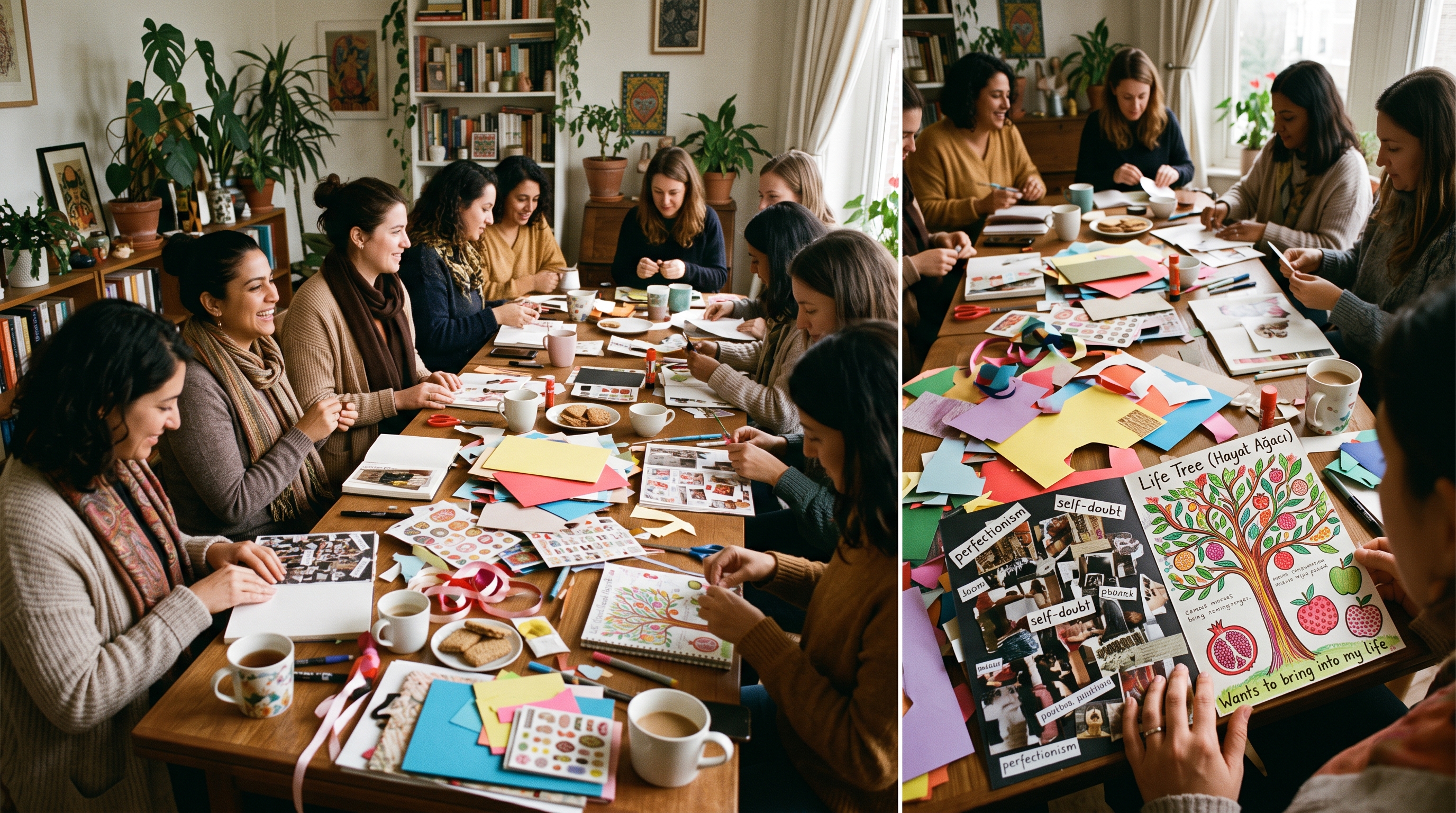
For the final part of the workshop, they laid out materials on the table reminiscent of primary school craft sessions: colorful cardstock in various textures, stickers, ribbons, scissors, colored pencils, and glue. Kristy handed each of us an A4 card and asked us to split it mentally down the middle to create a design. We were free to use whatever materials we liked—we could draw, write slogans, anything. The left side was meant to represent what we wanted to let go of, and the right side what we wanted to invite into our lives.
We dove in with genuine enthusiasm, looking just like young girls brought together by their mothers for a playdate. It was clear we were all yearning for something, but whatever that was, it wasn't too late. As we politely shared and passed materials around, new members introduced themselves and shared their stories. Along the way, conversations took unexpected turns. Sometimes, a group of strangers offers a safer space to open up about personal matters—simply because no one knows you well enough to judge. Whatever was shared at that table that day was going to stay there.
I lost all track of time; the two hours flew by. When I finished, I looked down at the card in front of me. I had managed to fit so much of what I hadn't been able to voice. On one side, I had buried my self-doubting, perfectionist self; on the other, I had drawn a flourishing tree of life.
Let’s see if you can guess what fruit is growing on its branches.