The Body Remains, But the Mind Has Departed
One of the smells woven into the fabric of my childhood was the sour-cherry pudding my grandfather used to make with painstaking care. Back then, we didn't have fancy tools to pit cherries. The kitchen would end up in absolute chaos, and my grandmother would unleash a storm of gentle complaints.
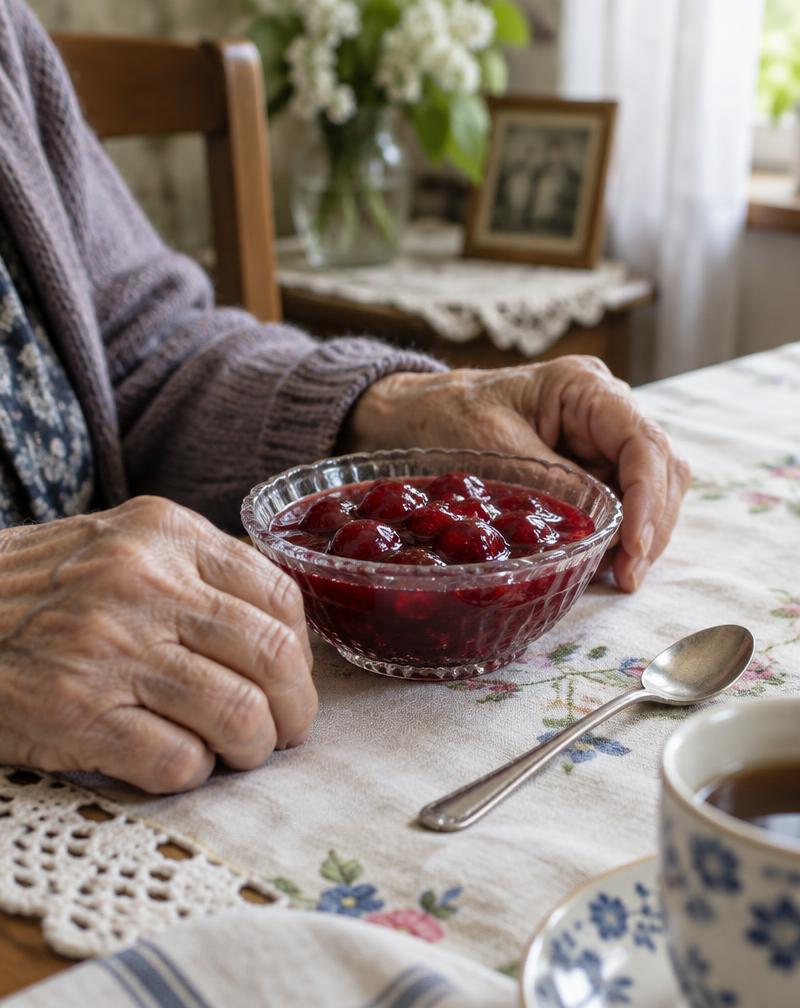
Once finished, the dessert was left to cool in crystal glassware that showcased its vibrant, ruby color. It was impossible to forget, neither its tart, sweet flavor nor the rich aroma of cherries simmering over a low flame for hours, filling the entire house.
Years later, while pregnant, I woke up one morning craving that exact sour-cherry pudding. I was heading over to visit my family that afternoon, and while catching up with my grandfather, I asked him for his famous recipe.
When he looked at me and said, "I’ve never made sour-cherry pudding in my life," I assumed he was pulling my leg. But when he stubbornly stuck to his answer, I didn't push it. It felt as though he had deliberately stepped out of a cherished childhood photograph, leaving me standing alone with my memories. Looking back, my reaction was childish, but at the time, I felt deeply hurt that he couldn't remember a moment so precious to me.
A few weeks later, we went out for a family dinner. After skimming the menu, I overheard him lean toward my grandmother and whisper, "Müjgan, do I like meatballs?"
It felt like a punch to the gut. How could someone forget what they loved to eat? In an instant, my earlier resentment vanished, replaced by profound empathy.
Back then, public awareness around Alzheimer’s disease was nowhere near what it is today. When elderly relatives lost their memory, people simply brushed it off as "getting senile." But my grandfather’s dementia—which began shortly after his hearing loss—was clearly progressing at a frightening pace.
Thankfully, he wasn't alone; my grandmother was there to run the household. Not long after that dinner, he passed away quietly, leaving us like a bird taking flight without ever becoming a burden to anyone.
Years later, watching Florian Zeller’s The Father (2020), starring Anthony Hopkins and Olivia Colman, every single one of those memories came flooding back.
The film follows Anne (Colman) as she navigates the agonizing decision to place her father, Anthony (Hopkins), into a care facility as his Alzheimer’s worsens. As Anne strives to ensure his safety, she grapples with the unique grief of watching him slip away, effectively mourning a parent who is still alive.
By repeating conversations across shifting settings and characters, the movie places the viewer directly inside the disorienting perspective of someone living with dementia. It forces us to share in the acute anxiety, confusion, and sorrow the disease inflicts.
By the film's end, Anthony finds a safe environment in a specialized care facility. In Turkey, however, families facing advanced-stage Alzheimer’s find their options severely limited.
The Unseen Burden on Women
According to the Alzheimer’s Association of Turkey, roughly 600,000 families in the country are navigating the disease. The heavy responsibility of caring for the elderly, sick, and disabled-including those with Alzheimer’s—falls overwhelmingly on family members, and predominantly on women.
When a loved one’s health declines, families without the financial means to afford private care facilities or full-time nursing have little choice: a family member must step up as a primary caregiver. For working women, this almost always means leaving the workforce.
Prof. Dr. İsmail Tufan, founding chair of the Department of Gerontology at Akdeniz University, emphasizes that Alzheimer’s care in Turkey is effectively subsidized by women's unpaid labor. He points out that when a woman is forced to quit her job and stay home, it deals a double blow: it hits household finances hard and strips the caregiver of social security, plunging her into deep burnout.
Alzheimer’s can span 10 to 15 years, requiring round-the-clock vigilance, patience, and emotional fortitude. The financial and psychological toll is immense.
Research conducted under the "Structured Caregiver Support Program" at Akdeniz University highlights the severity of the crisis: clinical-level burnout was detected in 78.6% of informal family caregivers looking after Alzheimer’s patients at home in Turkey.
State Care Homes: Long Lists, Short Capacity
Turkey’s demographics are shifting rapidly. The population aged 65 and older grew by 20% over the last five years, reaching nearly 8 million in 2020, and is projected to make up 13.5% of the total population by 2030. This demographic pivot is crucial: as the population ages, cases of dementia are climbing in tandem.
Yet, while the elderly population grows, state-backed care infrastructure is failing to keep pace. Recognizing these demographic realities, the Ministry of Family and Social Services has attempted initiatives aimed at integrating seniors into society rather than viewing them merely as care recipients. Measures include declaring the "2026–2035 Decade of Family and Population," hosting regular Council on Aging summits, and announcing plans for a Long-Term Care Insurance System.
However, fixed cash allowances under these programs risk being rendered ineffective by high inflation.
Prof. Tufan argues that current care subsidies fall far short of meeting a patient's basic requirements:
"The care allowance given to family members today can never offset the economic loss of a worker withdrawing from the labor force. When you factor in the cost of diapers, specialized nutrition, medication, and medical supplies, this allowance covers less than a quarter of total expenses. Instead of relying on cash handouts, we urgently need a comprehensive 'Social Care Insurance' model that provides both financial support and direct care services."
Meanwhile, state-run care facilities specialized in dementia remain scarce. With overwhelming waitlists, securing a spot can take months or even years. Prof. Tufan notes that unless a case is deemed an extreme emergency, getting immediate placement is nearly impossible:
"If a family caregiver falls ill and needs hospitalization themselves, who looks after the patient? Don't assume other relatives will line up to take over. Experience tells us the exact opposite."
Daycare Centers: A Crucial Lifeline
Given current economic realities, placing a relative in a private nursing home is not only emotionally challenging, but financially prohibitive—a luxury reserved for the privileged few.
Could municipal adult daycare centers offer a middle ground? Prof. Tufan views these centers as valuable, but stresses they cannot offer a lasting solution unless scaled up dramatically:
"For a caregiver to catch her breath even for a few hours a day—to attend to her own health and basic needs—these daycare centers must exist in every neighborhood. I recommend at least one facility for every 5,000 residents."
Quality of Care and Professional Oversight
Another critical issue in dementia care is the specialized quality of service required. Prof. Tufan highlights that Alzheimer’s patients require neurological monitoring, wander-prevention architecture, and staff trained in gerontology and psychogeriatrics to handle acute distress. Standard state facilities, designed primarily for general elder care, are ill-equipped to handle these complex needs.
He also critiques the commercialized mindset governing both public and private care homes in Turkey, pointing to a lack of transparency in how inspections are conducted and by whom. At the heart of the problem, he argues, is that caregiving is still not treated as a respected, professional career path.
Drawing a sharp line between medical nursing and holistic elder care, Tufan summarizes:
"Medical treatment belongs to nurses. But elder care goes far beyond nursing—it requires empathy, emotional support, moral responsibility, and physical presence. 'Care' doesn't end when you hand over a pill or change a dressing."
Urging gerontology graduates to champion their field, Tufan insists that elder care is a fundamental human right that should never be reduced to a profit-and-loss equation.
A Safe, Peaceful, and Dignified Life
Watching an active, independent adult gradually lose the ability to perform basic tasks—becoming increasingly estranged from the world around them—is one of the most painful journeys a family can endure. It elevates Alzheimer’s from a medical condition to a profound social crisis.
While medical science works toward a cure, a compassionate state must build structural safety nets that allow both patients and their families to live with dignity.
Key priorities must include updating financial support to match real-world living costs, expanding the capacity and quality of public care facilities, and giving informal caregivers easy access to mental health support.
In the closing scene of The Father, Anthony, no longer knowing who or where he is, breaks down in tears, helplessly begging his nurse to take him "home." That lost "home" isn't just a place—it represents our most basic human desire for safety and belonging.
Even if they cannot retain the memories of their final years, every person living with Alzheimer’s deserves to spend those years in peace, safety, and dignity. Remembering that any of us could one day walk that same path, ensuring they receive that care is a debt we all owe.