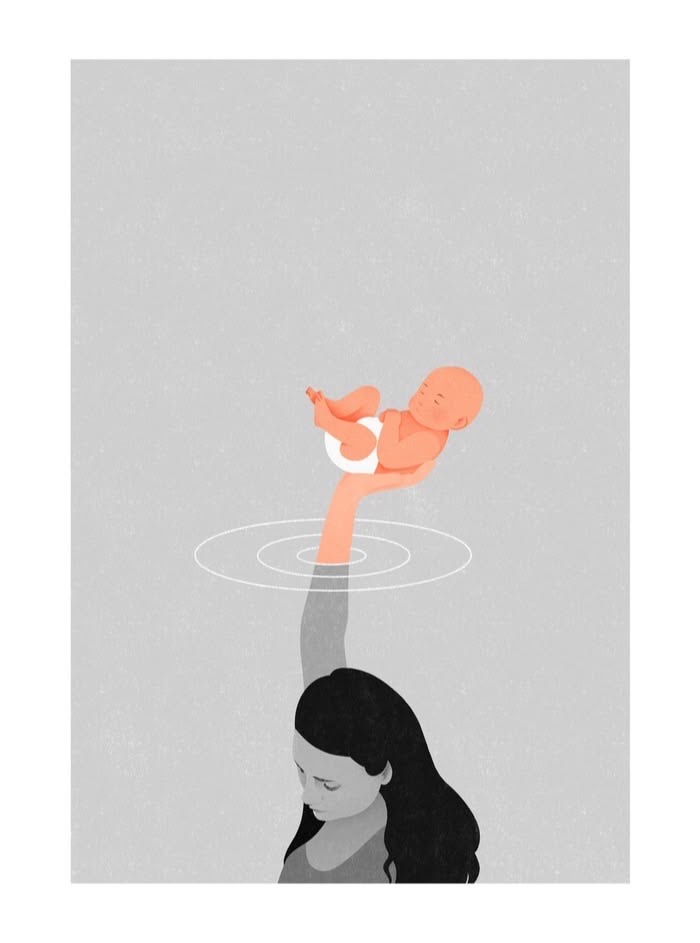
As Mother’s Day rolls around, I always notice two competing camps fighting to shape public opinion. The first group can’t stop sanctifying and praising motherhood. Meanwhile, the second group shushes the first, pleading: "Let’s not hurt women who can’t have children or who have lost their mothers, and let’s not pressure women to give birth."
Why must we split into extremes on every issue, raising one perspective to the heavens while tearing the other down? Motherhood cannot be defined solely by childbirth; it should be measured by the love, labor, and care invested in raising a child. In that sense, it should encompass anyone who nurtures and cares for a living being. Yet, I also refuse to stay silent when the transformative experience of birth mothers is suppressed simply to avoid offending someone.
Fortunately, a third wave has gained momentum in recent years to bridge this gap. This third group lifts the curtain on the rarely discussed physical and emotional toll of the postpartum period. They champion the idea that maternal instinct doesn't manifest identically in every woman, and they demand real recognition for the caregiving work mothers perform.
Finally, centuries later, society is slowly recognizing that if "heaven lies at the feet of mothers," it’s because they endured hell and lived to tell the tale—while courageously acknowledging that some do not survive the experience unbroken. The recent surge in books and films exploring postpartum depression is a clear sign of this growing awareness. Frankly, I find this third perspective far more authentic and grounded in reality.
The Unfiltered Reality of Postpartum Life
Chatting with a friend recently, she admitted: "If I had a daughter, I couldn't bring myself to tell her to hurry up, get married, and have kids. I just couldn't do that to her."
I agreed. We belong to the same generation. In the life plan mapped out for us by our parents, a career was optional, while marriage and children were treated as the primary highway.
I was just 24 years old when I held my first baby. Looking back, I was still a child myself. Having children young certainly has its advantages, but I will never forget those first weeks after coming home from the hospital—dazed from sleep deprivation and doubled over in pain from my stitches.
I vividly recall stepping into the shower, desperately trying to wash away the smell of leaking milk, sweat, and baby vomit on my shoulder. Terrified by the blood clots passing between my legs, I collapsed into the tub and sobbed uncontrollably as the water ran over me. It was one of the rare rock-bottom moments of my life.
Though I was deeply in love with my baby, I was a complete novice, struggling to decipher his needs. He suffered from colic. Today, I realize those crying fits were partly caused by my own stress passing onto him. But back then, I would hold him with superhuman patience, trying for hours to soothe him to soft music.
Every visiting relative and acquaintance offered unsolicited advice. That backseat driving infuriated me to the point where I wanted to chase them all out of the house with a broom.
I felt like an animal driven wild by postpartum hormones. That’s why the scenes in the postpartum depression film Die, My Love, where Jennifer Lawrence’s character Grace paces like a caged tiger, struck such a deep chord with me.
On one hand, I growled at everyone around me, just like Grace; on the other, I slept with my ears strained for the slightest baby noise, living mechanically in an endless cycle of feed, sleep, eat, nurse.
And while I’m on the subject, let me send a personal greeting to anyone who says, "You should sleep when the baby sleeps." Has any mother ever actually managed that? Found that absolute peace and quiet, closed her eyes without a care, and drifted into deep sleep? If she exists, I’d gladly hand over my Mother’s Day gift to her.
Unrealistic Expectations and Physical Realities
To make matters worse, when I gave birth, celebrity Ebru Şallı was at the height of her popularity. Just as model Kate Moss poisoned my teenage years by making extreme thinness the ideal, Şallı’s headlines flooded my postpartum period with declarations like "In my marriage, my husband comes first" and "How I regained my pre-baby body in days through Pilates."
In my daily grind, let alone finding time for exercise, I lacked the energy entirely. Looking in the mirror, I still looked pregnant—only far less put-together.
As I struggled with sore, cracked breasts sticking to my clothes, the thought of undressing—let alone trying to look attractive for my husband—felt light-years away. Still, thinking Şallı might know something I didn't, I eventually attempted to restart our intimate life, only to be met with a full-blown physical shutdown.
I’ll never forget grabbing my phone to call my gynecologist, describing the situation in my own blunt words: "Doctor, what did you do in there? Did you sew me completely shut? Did you pour concrete?"
He replied calmly: "You've developed vaginismus; it will pass in a few months, don't worry." Naturally, my mind fixated on: What if it doesn't?
None of this, of course, was mentioned in What to Expect When You’re Expecting.
My entire life structure had changed in ways I felt completely unprepared for. I had no time or space left for myself, living with a constant weight of responsibility sitting heavily on my chest.
Of course, as my baby grew, the physical burden would lighten, and I would eventually reclaim my personal freedom. But in those early days, it felt as though my life was going to remain like that forever.
The Lifeline of Community
What saved my sanity was a weekly gathering with my women friends. Without those meetups, I might have met a fate similar to Grace’s.
Our group consisted of three women who had given birth around the same time, alongside four more experienced mothers. Every Wednesday, we brought our children together for a few hours that felt like group therapy. It provided both a release and a treasure trove of non-judgmental advice. Thanks to them, I navigated the steepest hurdles of early motherhood.
Motherhood is an identity that doesn't necessarily begin with birth, but once assumed, it requires a lifetime of service. Though harder than any profession, it isn't officially recognized as one—perhaps because its true cost cannot be quantified in financial terms.
The return you receive -a smile, a hug, or that thoughtful phone call once your child grows up and leaves the nest- is truly priceless.
That’s why I support celebrating Mother’s Day not only to honor our own mothers, but also to honor our own journey as mothers. And to do so with all the joy and warmth it deserves.
To everyone who gave us birth, and to everyone who nurtures life: with deep love and gratitude.