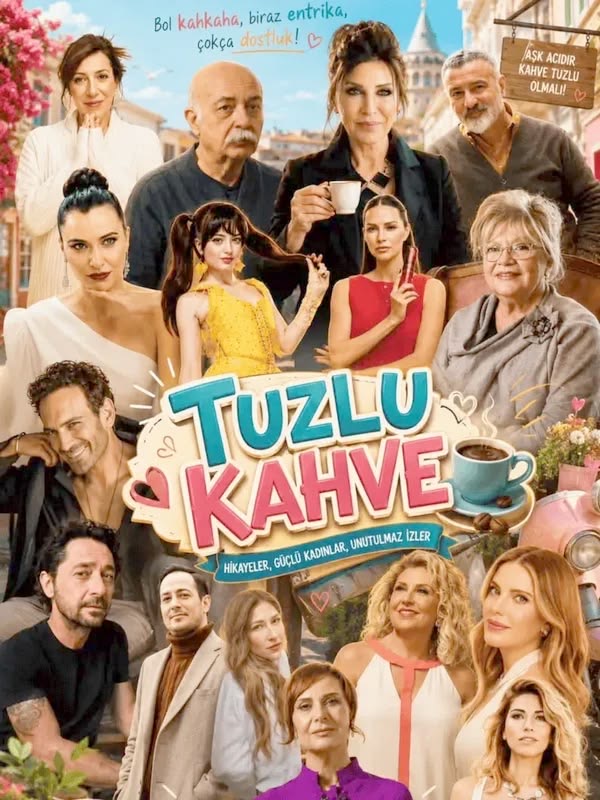
My family and I have been watching the TV series Tuzlu Kahve (salty coffee) ever since it first premiered. In a broadcast landscape dominated by dark dramas, it is a breath of fresh air: nobody gets gunned down in the streets, and relationships aren't built solely on betrayal. On top of that, it boasts a stellar ensemble cast that pairs seasoned veterans with promising new talent. Best of all, it's a genuine comedy—a rare comfort in recent years. Coming home and turning on the TV in the evening to shed the day's fatigue is exactly what we had been looking for.
For those who haven't caught it yet, here is a quick recap: the plot revolves around three wealthy Istanbul families trying to marry off their grown children. Hatun Anne, the matriarch of the Aydınoğlu family from Adana, dotes intensely on her three sons. However, her attachment to Mehmet is on another level. Having nearly lost him during a difficult birth, combined with a nightmare that he would drown as an infant, she developed a fierce, overprotective streak. In fact, much of the show’s plot and humor stem from her relentless smothering.
The character is brought to life by the beloved Binnur Kaya—or rather, inhabited by her. She brings such natural charm to the role that it is virtually impossible to stay mad at any character she plays. Yet, Hatun Anne breaks every rule in the book when it comes to healthy boundaries with an adult child. Desperate to keep her twenty-something son from returning to the United States, she tries to rush him into marriage. She secretly stalks him on dates. Worried when he isn't home late at night, she sets a ladder against his window to spy into his room. When he is in bed texting his girlfriend and explicitly asks for privacy, she curls up next to him anyway to pitch names for her unborn grandchildren. She even crashes his wedding proposal! And her sole justification for crossing every boundary? Pure, unadulterated motherly love.
The trope of the overbearing mother—especially toward her son—is a familiar sight in Turkish television. Yet, Hatun Anne isn't cold, authoritarian, or openly manipulative like Esma Sultan in İstanbullu Gelin. Instead, she appears warm, affectionate, and endlessly giving. However, that sweet exterior does not change the underlying reality: her boundless affection represents a deeply suffocating and unhealthy attachment.
Wrapping toxic behavior in a blanket of innocence carries real risks. As real-life "Hatun Annes" watch these scenes at home, do they recognize the boundary violations, or do they feel validated, believing their own intrusive habits are merely acts of love? Popular television shows don't just reflect cultural norms; they shape them. In that sense, Tuzlu Kahve holds a valuable opportunity to guide its audience through the personal growth and evolution of Hatun Anne.
What looks sweet and humorous on the surface often carries a high social cost. Let’s take a closer look at what experts say about how these boundary breaches, masked as love, can quietly undermine an adult child's life over time.
When Love Suffocates: The Shadow Side of Motherhood
Stepping away from the colorful world of the show into the realm of human psychology, this intense over-attachment often points to something much deeper. Carl Jung, the founder of analytical psychology, noted that the mother archetype in the collective unconscious has a dual nature: while nurturing and protective, it also possesses a dark, suffocating side. Jung framed the subconscious impact of a person's relationship with their mother around the concept of the "mother complex."
In women driven heavily by this maternal archetype, the complex manifests as total identification with those they care for. Claiming to sacrifice everything for her children, this type of mother conceals a subtle form of control beneath a mask of selflessness. The less self-aware she is, the stronger her subconscious need to dominate her child's life becomes.
Similarly, Jung’s student Erich Neumann described this dynamic in The Great Mother using the concept of the "devouring mother." While the "good mother" nurtures and encourages independence, her darker counterpart prevents the child from standing on their own two feet to preserve her own influence. She effectively consumes her child's autonomy, weaponizing affection into emotional leverage to keep them codependent.
The Armor of Innocence and Territorial Defense
On the surface, Hatun Anne’s intrusive antics—humiliating her son in front of his girlfriend under the guise of wanting him to settle down—might seem like harmless, quirky comedy. Psychologically, however, it is a territorial maneuver. She represents a mother trying to fulfill her own unmet emotional needs through her son. Indeed, Hatun Anne admits to having had children at a young age, growing up alongside them like playmates, and feeling deeply lonely once they matured and moved out. Unable to accept that they need lives of their own, she insists on keeping them close—ideally under the same roof.
A scene in which Hatun Anne joins hands with Mehmet and his girlfriend Derin during his marriage proposal perfectly encapsulates this boundary issue. Subtextually, it broadcasts a suffocating message: "You cannot survive out there without me; you are only safe under my wing."
What makes this archetype particularly tricky is the shield of good intentions: "I only want what's best for my child." Setting boundaries becomes extraordinarily hard for a son when his mother hides behind this armor of innocence. Even when embarrassed in front of his partner, he feels guilty getting angry at someone who appears so loving and harmless. This armor strips the child of their right to break free and assert independence. It is a subtle form of paralysis, serving poison coated in honey.
Healthy Parenting: Striking a Balance
What does a healthy parent-child bond look like? Psychologist Prof. Dr. Ayşe Bilge Selçuk compares the main pitfalls of parenting to dietary traps, highlighting three behaviors to avoid: overprotectiveness, over-control, and over-involvement. The ultimate goal of raising children is to help them become self-sufficient. Overprotective parenting prevents that emotional muscle from ever developing.
According to Selçuk, raising a child often requires parents to grow up themselves. Parents may carry pre-existing anxieties or emotional baggage before having children. Healthy parenting demands self-awareness and balance; it challenges parents to step out of their comfort zones and address their own flaws rather than projecting their anxieties onto their kids.
Children naturally need guidance as they grow. Selçuk describes healthy parenting as a progression: parents walk in front of the child first, then beside them, and eventually step behind them to offer support from a distance. While emotional warmth remains constant, physical and operational independence must increase over time—a shift that requires maturity and emotional balance from the parents.
True Love Sets Free
Tuzlu Kahve has clearly struck a chord with viewers. Many watching at home likely cringe at Hatun Anne’s interventions, thinking, "Stop smothering him or you'll drive him away!" While no one wants to see Binnur Kaya’s endearing character suffer, there is a real opportunity here for narrative growth. Seeing Hatun Anne learn from her mistakes and mature would send a powerful message: true love isn't about control; it's about respecting your child's autonomy.
Beyond the screen, the real challenge lies in how we handle these dynamics in our own lives. Perhaps the real test for the "Hatun Annes" within us is learning to fill the void left behind when our children spread their wings. A mother doesn't liberate her child by keeping them in her shadow, but by feeling whole in her own right. Motherhood shouldn't mean condemning our adult children to swallow a gilded poison like a cup of “salty coffee,” masking smothering control as sweet affection.