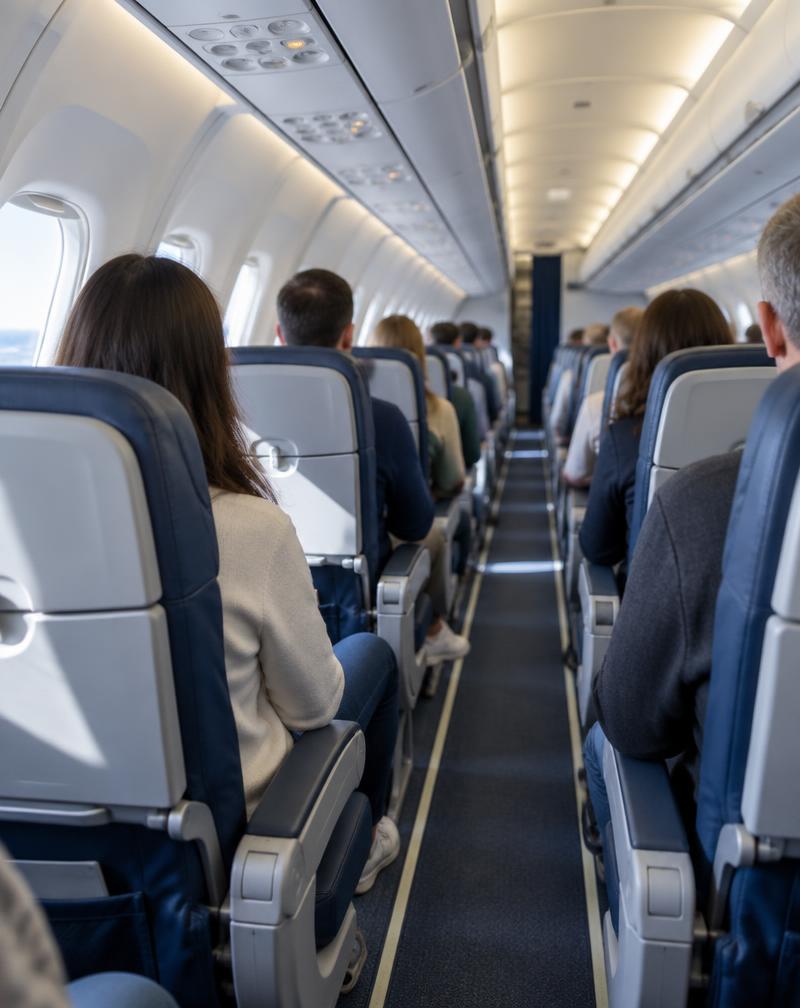
Are screaming infants truly the worst part of flying? Or is the real culprit a deeper, collective decay of basic consideration in our shrinking middle seats? Guided by the firsthand accounts of flight attendants and the unseen stories of passengers, let’s take a trip above the clouds to ask why common courtesy seems to have hit major turbulence.
We’ve all had one of those flights—the kind where you’re far too stressed in the moment to laugh, even though the sheer absurdity would make for a brilliant dark comedy. When you land next to the wrong person, shared travel turns into absolute torture. The hours drag on, and unlike a bus, you can’t exactly pull over and jump out. You are completely at the mercy of fate until touchdown.
A few weeks ago, Turkish pop singer Cenk Eren sparked a heated online debate by complaining about loud kids on planes, proposing that airlines offer child-free flights.
Biologically, nature has engineered human infants to cry at pitch-perfect, glass-shattering frequencies to ensure survival. Even if it’s your own child, that sound pushes the absolute limit of human tolerance. I fully agree that being trapped with it in an enclosed space amps up travel anxiety. But let’s be honest: are crying babies really our only issue when we fly? Let's take a look in the mirror and examine how we, as adults, behave above 30,000 feet.
The Race Against the Clock
The bags are lined up by the door. You run through the final mental checklist: plants watered, trash emptied, appliances unplugged, lights off… Luggage in one hand, phone in the other, you stand at the curb checking traffic while waiting for your ride.
The stopwatch is ticking. Everything is geared toward one goal: making that flight on time.
Air travel may shrink distances, but for almost anyone—even those without a fear of flying—it’s an inherently high-stress ritual. Unlike other modes of transport, it demands meticulous planning. You have to calculate everything down to the ounce of your suitcase and the minute you step out the door.
Once you reach the airport, your patience is tested by endless security lines, check-in queues, and passport control.
Assuming you clear all those hurdles and arrive at the gate on time, the real trial begins the moment you step onto the aircraft.
The pre-flight rush gives way to claustrophobia, restricted movement, and the unsettling feeling of having zero control. Consider the moment you finally survive the blood-sport of finding overhead bin space and sink into your seat. The second you close your eyes to breathe a sigh of relief, a baby’s wail echoes through the cabin. Brace yourself: it’s going to be a long flight.
Infants get fussy for good reason. They are overwhelmed by the roar of the engines, the PA announcements, and the agonizing ear pressure caused by changing altitude on their underdeveloped ears. But the people who truly ruin your trip aren’t the infants with genuine biological excuses. They’re the adults.
The Recline Wars and Other Cabin Crimes
You settle in, hoping to grab a bite and relax. Just as you’re wrestling with the greasy foil lid of your inflight meal, the person in front of you slams their seat back without warning. The tray table is now smashed against your stomach, spilling food everywhere. Resigned, you bolt your seat upright, only for the kid behind you to land a solid kick directly into your kidneys.
And it doesn't stop there. Suddenly, a group of passengers decides to hold a social hour right above your head, leaning on your headrest. Apparently, these people—who last saw each other yesterday evening—have a mountain of catching up to do. The flight goes on, but their loud chatter never ends. Your passive-aggressive side-eye only works half the time.
Let’s say you get lucky and they finally return to their seats. You've eaten, you're feeling groggy. Prime time for a nap. But wait: the passenger across the aisle decides to watch loud videos on their phone without headphones. Do these people not wonder why airlines put earbuds in seat pockets, or what kind of hellish cacophony would ensue if everyone played their audio aloud?
You mutter a quiet prayer for patience, pop in your own noise-canceling headphones, and try to tune out the world over a cup of coffee. Just then, an odor wafts over that completely overwhelms the aroma of your drink. You glance beside you, hoping it’s not someone sneaking a trip to the lavatory in their socks, only to find your seatmate resting their bare feet, fanning out their toes after slipping off their shoes. Your only defense against this aromatic concoction of sweat and stale leather is to press your coffee cup tightly against your nose.
The Art of Entitlement
None of this is exaggerated; it’s a collection of true stories. I’m not saying parents traveling with kids are always perfect models of consideration. But compared to the selfish choices of grown adults, a baby’s helpless crying seems entirely innocent.
The worst part is what happens when you politely ask someone to stop. Among today’s flying public, the phrase "Excuse me" has been replaced by a defensive knee-jerk reaction, an art form of shifting blame that paints you as overly sensitive, dramatic, or snobbish. Somehow, you end up feeling like the bad guy for raising a valid point.
What’s more, these disputes rarely stay between two passengers. They spread like wildfire through the cabin. Before you know it, factions form, everyone has an opinion, and people are more than happy to throw fuel on the fire.
In those moments, restoring order falls squarely on the flight attendants. To explore this rising tide of air-travel rudeness—and how we might reclaim a culture of shared respect—I spoke with the unsung heroes of the cabin.
Voices from the Sky
Zarife Banu Atılgan, President of the Turkish Airline Cabin Attendants Association (TASSA), sees the democratization of air travel as a net positive, but highlights the downside:
"Thanks to digitalization and social media, passenger expectations have become hyper-personalized. Real-time posts about travel experiences directly shape how people perceive our service."
Despite these structural shifts, Atılgan maintains that mutual respect and common sense remain the bedrocks of a good flight.
Zeynep Yıldöner, a purse/cabin chief with 16 years of experience at Turkish Airlines, is less optimistic. She notes that while modern passengers are well-informed, they are increasingly impatient and struggle with authority:
"Even the gentlest, most polite reminder to follow a safety rule can trigger an aggressive reaction."
So, how do we de-escalate this altitude-induced tension?
Could airlines append a quick, lighthearted video on cabin etiquette to those standard safety demonstrations we watch before takeoff?
When I suggested this, both Atılgan and Yıldöner enthusiastically agreed, noting it would make the crew's job considerably easier. Atılgan emphasizes that the goal isn't to police anyone, but to gently remind passengers that people with vastly different needs are sharing a very tight space:
"A brief, inclusive, non-judgmental video could go a long way toward building a better culture on board."
Unseen Stories
A flight attendant's job goes far beyond enforcing rules; they constantly absorb the emotional baggage of hundreds of strangers.
Yıldöner shared a memory from a early-morning flight. She noticed a young woman sitting quietly, looking entirely lost. When she struck up a conversation, she learned the passenger was rushing home to attend her father's funeral. Yıldöner sat next to her for a moment and listened:
"Before descent, she turned to me, held my hand, and said, 'Just having someone to talk to helped so much.' She hugged me as she left. That day reminded me that being a flight attendant isn't just about managing a cabin; it’s about being there for people during their hardest moments."
Hearing these accounts makes you appreciate just how demanding this work is, and how much empathy it requires. If only passengers could extend that same empathy to one another.
As if reading my mind, Atılgan reflected on her 30-year career:
"I’ve flown as a pregnant woman, and as a mother with a young child. I’ve also boarded a plane as a grieving daughter, carrying my mother’s body in the cargo hold below. Those experiences taught me one thing: every single person on a plane carries an unseen story. You never know what someone next to you is going through, or what joy or grief they’re carrying. In aviation, understanding people is just as vital as flight safety."
A Shared Fate Above the Clouds
These testimonies point toward a clear truth: the problem isn't that passengers want comfort, but that too many seek it at the expense of others.
We far too easily forget that the cabin is a shared community space, however temporary. In an ideal world, self-awareness would kick in naturally and people would respect personal boundaries. But where basic consideration fails, airlines stepping in to outline a clear code of conduct might be the middle ground we need.
To help jumpstart that effort, here is a quick starter guide to basic inflight etiquette:
Store your overhead baggage directly above your own seat so you don't take up space meant for others.
Exercise patience during boarding and deplaning. Wait for the row ahead of you to move instead of cutting in.
Ask before reclining. Always bring your seat back upright during meal service out of courtesy for the person behind you.
Mind your personal space. Keep your elbows within the boundaries of your own armrest.
Keep your shoes on. Recirculated cabin air means odors travel fast.
Keep your voice down so your conversation stays between you and your seatmate.
Bring quiet, screen-free activities if you're flying with young children.
Always use headphones when watching videos or playing games on smart devices.
Yield both armrests to the middle seat passenger—they already drew the short straw.
Prepare your child for the flight. Pack quiet distractions, and if you have an infant, putting together small "thank you" care packages (like earplugs or treats) for nearby neighbors is a thoughtful touch.
At the end of the day, it’s not just babies who get cranky in midair—adults do, too. Making travel pleasant comes down to a simple pair of headphones, a bit of patience, and, above all, a little grace for the unseen stories sitting right beside us.
After all, we’re all squeezed into the same tight space, eager to get back to the lives and people we love.